Skip to content
 Medically Reviewed
Written by Pooja Rawat, Medical Content Writer
Moxifloxacin eye drops or solution are prescribed by Ophthalmologists to treat eye infections, including bacterial conjunctivitis. This medicine belongs to a group of medicines known as fluoroquinolone antibiotics that work by killing bacteria that are responsible for conjunctivitis.
It is important to not self-prescribe moxifloxacin eye drops to yourself if you have any eye infection-like symptoms. The Best Eye Doctor in Thane will order a detailed diagnosis for proper differentiation, as bacterial pink eye needs antibiotics, while viral pink eye (more common) does not and must run its course.
How Moxifloxacin Eye Drops Work | The Mechanism
Moxifloxacin is a fluoroquinolone antibiotic. It is known for its broad-spectrum bactericidal action, meaning it can act against a wide range of bacteria.
It shows its action by inhibiting the action of two vital bacterial enzymes, DNA Gyrase (Topoisomerase II) and Topoisomerase IV.
- DNA Gyrase (Topoisomerase II): Bacteria need this enzyme for unwinding and managing DNA supercoiling during replication and repair.
- Topoisomerase IV: Bacteria need this enzyme for separating newly copied DNA strands during cell division.
Moxifloxacin sneaks in and jams these two key worker enzymes. Without these enzymes, the bacteria can’t multiply, repair and survive themselves, so they die off naturally.
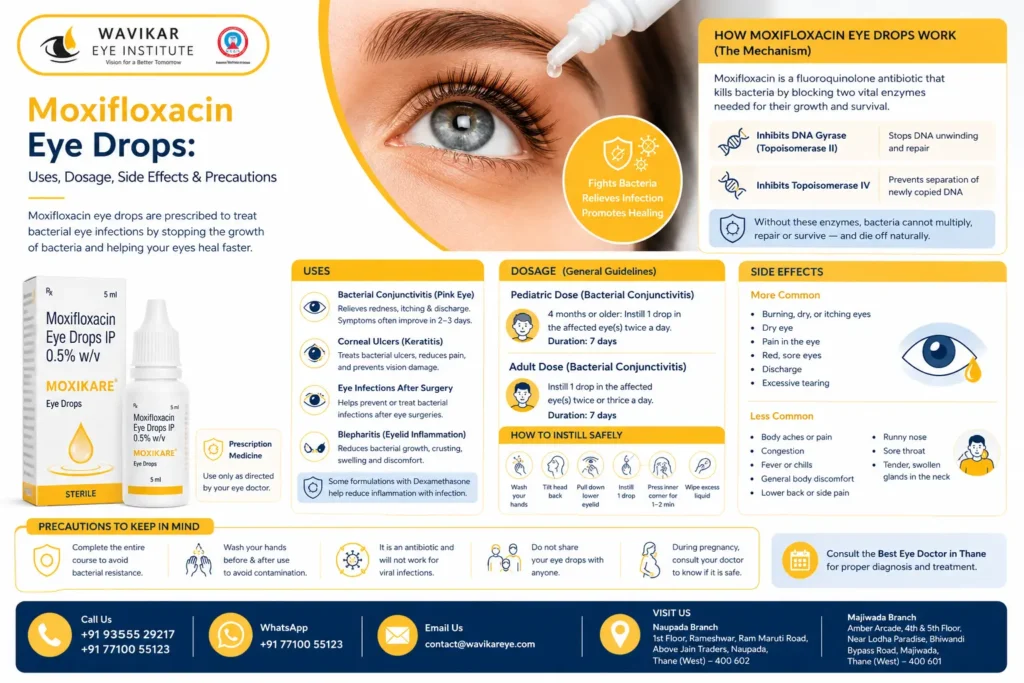
What are the Uses of Moxifloxacin Eye Drops
After proper diagnosis of your eye condition, The Best Ophthalmologists, like those at Wavikar Eye Institute, may prescribe it for the following eye conditions:
Bacterial Conjunctivitis by Staphylococcus (Pink Eye)
This is the most common approved use. It effectively targets bacteria and subsides symptoms like redness, itching, and discharge on the eye’s surface. Based on the severity of the condition, you may observe symptoms often improve in 2-3 days with twice-daily drops for a week.
Also Read: Protect Your Eyesight: Key Vitamins And Supplements For Healthy Vision
Corneal Ulcers Due to Bacteria (Keratitis)
It kills and stops the growth of bacteria, causing painful corneal sores (inflammation of your cornea) and preventing vision damage. These prescription-based drops penetrate deeply to kill germs and promote healing.
Eye Infections After Surgery
Cataract surgery often carries a rare risk of eye infection, particularly a serious condition called endophthalmitis. The Best Eye Doctor in Thane can prescribe moxifloxacin eye drops to prevent or treat bacterial issues after procedures like cataract surgery. Local delivery decreases inflammation and infection risk quickly.
Also Read: Myopia vs. Hypermetropia: What’s the Difference and How to Manage Them?
Blepharitis (Eyelid Inflammation)
This drop targets bacterial proliferation along eyelids, causing crusting and swelling. Regular use can help relieve discomfort and clear flakes.
There are some formulations of moxifloxacin with dexamethasone that are used to treat inflammation associated with bacterial eye infections
Also Read:
Dosage of Moxifloxacin Eye Drops
The correct dosage will be recommended by your Eye Doctor based on the type and severity of the condition, the specific product and other individual factors:
Usual Pediatric Dose for Bacterial Conjunctivitis
- Aged 4 months or older: Instill 1 drop in the affected eye(s) twice a day.
- Duration of therapy: 7 days
Usual Adult Dose for Bacterial Conjunctivitis
- Instill 1 drop in the affected eye(s) twice or thrice a day.
- Duration of therapy: 7 days.
How to Instill Safely
- Always follow your doctor’s instructions.
- Wash your hands thoroughly.
- Tilt your head back.
- Gently pull down your lower eyelid to form a small pouch.
- Instill one drop into the pouch.
- Repeat the same for the other eye (if recommended).
- Close your eye and gently press your finger on the inner corner of your eye (near your nose) for 1-2 minutes to prevent the medicine from draining out.
- Wipe away any excess liquid.
Moxifloxacin Eye Drops Side Effects
It is commonly known to cause mild, temporary side effects. These side effects may go away once your body adjusts to the medicine. If these persist, always talk to your doctor; they will tell you about ways to prevent or reduce them.
More Common
- Burning, dry, or itching eyes
- Dry eye
- Pain in the eye
- Red, sore eyes
- Discharge
- Excessive tearing
Less Common
- Body aches or pain
- Congestion
- Fever or chills
- General body discomfort
- Lower back or side pain
- Runny nose
- Sore throat
- Tender, swollen glands in the neck
Precautions to Keep in Mind While Using Eye Drops Containing Moxifloxacin
Here are the precautions to keep in mind for its full benefits:
- Complete the entire course of medication to avoid bacterial resistance.
- Wash your hands thoroughly before and after use to avoid contamination.
- It is an antibiotic and will not work for viral infections.
- Do not share your eye drops with anyone, even if the eye symptoms seem similar.
- During pregnancy, consult your doctor to know if it is safe for you or not.
To Summarize
Eye infections can be due to bacteria, a virus, or fungi. Moxifloxacin only works against bacterial infections; that’s why you should consult an Ophthalmologist at the Best Eye Center in Thane to know the real culprit behind the infection.
Contact us:
Call: +91 93555 29217/+91 77100 55123
WhatsApp:+91 77100 55123
Email: contact@wavikareye.com