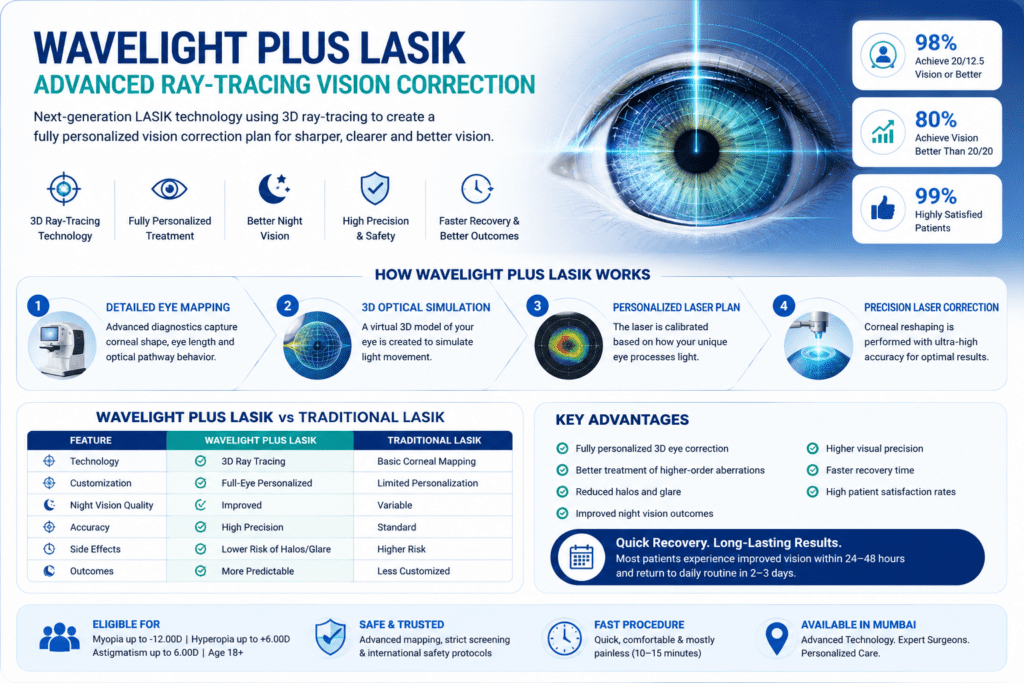
WaveLight Plus LASIK is a next-generation laser eye surgery that uses 3D ray-tracing technology to map the entire optical system of the eye and create a fully personalized vision correction plan.
It is designed to improve:
- Accuracy of vision correction
- Night vision quality
- Visual sharpness and clarity
- Recovery speed compared to traditional LASIK
This makes it one of the most advanced LASIK technologies currently available in India, especially for patients with complex refractive errors.
Read here: What Is Night Blindness? Symptoms, Causes And Treatment

What is WaveLight Plus Lasik
WaveLight Plus LASIK is an advanced refractive surgery that corrects:
- Myopia (nearsightedness)
- Hyperopia (farsightedness)
- Astigmatism
Unlike traditional LASIK, it uses ray-tracing-based 3D eye modeling, which simulates how light travels through every part of the eye, including:
- Cornea
- Lens
- Retina alignment
This allows surgeons to create a fully individualized surgical plan rather than a cornea-only correction approach.
Is There Any Clinical Study Supporting WaveLight Plus LASIK?
A recent AAO study found that ray-tracing guided WaveLight Plus LASIK outperformed SMILE Pro in visual outcomes. In a 60-patient trial, 98% achieved 20/12.5 vision or better, with superior precision, fewer aberrations, better astigmatism correction, and higher visual gains compared to SMILE Pro at three-month follow-up.
WaveLight Plus uses full-eye digital modeling (ray tracing):
Step 1: Detailed Eye Mapping
Advanced diagnostics capture:
- Corneal shape
- Eye length
- Optical pathway behavior
Step 2: 3D Optical Simulation
A virtual model of your eye is created to simulate light movement.
Step 3: Personalized Laser Plan
The laser is calibrated based on how your unique eye processes light.
Step 4: Precision Laser Correction
Corneal reshaping is performed with ultra-high accuracy.
Why WaveLight Plus LASIK is Better Than Traditional LASIK
| Feature | WaveLight Plus LASIK | Traditional LASIK |
| Technology | 3D Ray Tracing | Basic corneal mapping |
| Customization | Full-eye personalized | Limited personalization |
| Night vision quality | Improved | Variable |
| Accuracy | High precision | Standard |
| Side effects | Lower risk of halos/glare | Higher risk |
| Outcomes | More predictable | Less customized |
Key Advantages
- Fully personalized 3D eye correction
- Better treatment of higher-order aberrations
- Reduced halos and glare
- Improved night vision outcomes
- Higher visual precision
- Faster recovery time
- High patient satisfaction rates
Why WaveLight Plus Matters in 2026
In 2026, patients expect more personalized healthcare and more transparent information before making treatment decisions. WaveLight Plus fits this trend because it combines advanced diagnostics with individualized laser planning. For people who have higher-order aberrations or who are concerned about night driving, visual quality, and fine detail, this approach can be especially appealing.
Read Also: 5 Reasons to Consider Contoura LASIK for Your Eye Surgery
Is WaveLight Plus LASIK Safe?
Yes, WaveLight Plus LASIK is considered very safe when performed by experienced surgeons. Advanced eye-mapping technology and strict safety protocols help minimize risks and improve outcomes.
WaveLight Plus vs Contoura LASIK vs SMILE
WaveLight Plus LASIK
Best for:
- Full-eye optical correction
- Complex refractive errors
- Night vision issues
Contoura LASIK
Best for:
- Corneal surface irregularities
- Topography-guided correction
SMILE Surgery
Best for:
- Minimally invasive flapless correction
- Myopia cases only
Final decision depends on detailed eye evaluation by a refractive surgeon.
Read Also: Cataract Surgery Myths Vs. Facts: What You Need To Know
Who is Eligible for WaveLight Plus LASIK?
You may be eligible if:
Prescription Range
For example:
- Myopia up to -12.00 D
- Hyperopia up to +6.00 D
- Astigmatism up to 6.00 D
Age Requirement
- 18 years or older
- Stable vision for at least 2 years
Eye Health Conditions
You should NOT have:
- Corneal scarring
- Keratoconus
- Severe dry eye
- Eye infections
General Health
Conditions requiring caution:
- Diabetes
- Autoimmune diseases (lupus, rheumatoid arthritis)
- Pregnancy
Certain medications like corticosteroids or acne drugs may affect eligibility.
Is WaveLight Plus LASIK Safe?
Yes. WaveLight Plus LASIK is considered highly safe when performed by experienced refractive surgeons.
Safety is ensured through:
- Advanced pre-surgery eye mapping
- Strict eligibility screening
- Real-time laser tracking
- International surgical protocols
It is one of the most precise LASIK systems available today.
WaveLight Plus LASIK Recovery Time
- Vision improvement: 24–48 hours
- Daily routine resume: 2–3 days
- Full healing: 2–4 weeks
Most patients experience rapid improvement in clarity within the first 24 hours.
WaveLight Plus LASIK Cost in Mumbai (2026)
The cost varies depending on:
- Eye power and complexity
- Diagnostic tests required
- Technology used
- Surgeon expertise
In Mumbai, WaveLight Plus LASIK generally falls in a premium LASIK category, and exact pricing is determined after a detailed eye evaluation.
Is WaveLight Plus LASIK Worth It?
WaveLight Plus LASIK is worth considering if you want:
- Highly precise vision correction
- Better night vision quality
- Reduced dependency on glasses/contact lenses
- Advanced personalized treatment
It is especially beneficial for patients who previously had:
- Poor night vision with glasses
- High refractive errors
- Unsatisfactory LASIK outcomes in past evaluations
WaveLight Plus LASIK in Mumbai, India
In India, WaveLight Plus LASIK represents one of the most advanced laser vision correction technologies.
It is available at specialized eye care centers such as Wavikar Eye Institute, Mumbai, which is among the early adopters of this technology in India.
Patients benefit from:
- Advanced diagnostic systems
- Experienced refractive surgeons
- International safety protocols
- Personalized treatment planning
Which is Better: WaveLight Plus or Contoura LASIK?
- WaveLight Plus: Best for full-eye personalized correction using ray tracing
- Contoura LASIK: Focuses mainly on corneal surface irregularities
Your eye specialist will recommend the best option based on your eye condition.
Even though each patient is different, surgeons generally consider these five rules when deciding if a patient is a good candidate for WaveLight Plus LASIK eye surgery:
- Eyeglass prescription: Following are the eyeglass prescription requirements:
- up to +6.00 diopters of hyperopia,
- up to 6 diopters of cylinder/astigmatism
- up to -12.00 diopters of nearsightedness
- Age: This treatment is for individuals aged 18 years or older
- Overall eye health: One should have ocular maturity, a stable prescription (glass number is constant for at least two consecutive years. It’s critical that eyes are typically healthy and free from infections, injuries, and illnesses.
- Overall health: Certain health conditions and medications may interfere with the recovery process, making laser vision restoration an inappropriate option. Patients should disclose their complete health history with their doctor to ensure that a candidacy recommendation is based on all available information. To determine if you are a right candidate for the surgery, you must undergo a thorough eye examination that includes an array of advanced tests designed to screen patients for certain issues that may preclude you from being a candidate.
- Corneal shape and thickness: If your cornea is excessively thin or malformed, or if you have serious eye illnesses such as glaucoma or corneal scarring, you are unlikely to be a candidate for this procedure.
Following conditions and disorders can inhibit you from going for WaveLight Plus surgery:
- Cataracts
- Diabetes
- Autoimmune diseases like lupus or rheumatoid arthritis
- Pregnancy
Following medications can inhibit you from going for WaveLight Plus surgery:
- Corticosteroids
- Certain acne medications
Read Also: Cataract Surgery Myths Vs. Facts: What You Need To Know
WaveLight Plus LASIK Recovery Time
- Vision improvement: within 24–48 hours
- Resume daily activities: 2–3 days
- Complete healing: few weeks
WaveLight Plus in India
In India, WaveLight Plus is a cutting-edge LASIK technique that improves precision, safety, and recovery time for vision correction procedures. Experience the futuristic and advanced vision correction at Wavikar Eye Institute, the first in India to offer LASIK using WaveLight Plus! Experience unparalleled personalized treatment with a remarkable success rate.
Conventional LASIK is effective for many refractive errors but may not fully correct complex aberrations or provide a truly personalized outcome. WaveLight Plus, using ray tracing technology, maps and corrects these aberrations with unmatched precision. This represents a pivotal advancement in laser eye surgery, delivering customized treatments that improve visual outcomes and patient satisfaction.
Wavelight Plus LASIK Cost in Mumbai (2026)
The cost of Wavelight Plus LASIK in Mumbai depends on eye condition, diagnostic requirements, and technology used. A detailed consultation provides personalized pricing and treatment recommendations.
In Mumbai the cost typically ranges between ₹1,25,000 to ₹1,50,000 for both eyes.
Surgeon Expertise & Clinical Safety
Wavelight Plus LASIK is performed by experienced refractive surgeons following international safety protocols. Comprehensive pre-operative testing ensures suitability, accuracy, and long-term visual stability.
Conclusion
While conventional LASIK is helpful for a wide spectrum of refractive defects, it sometimes falls short of addressing complicated aberrations or producing outcomes customized to each eye’s unique characteristics. The Wavelight Plus method, on the other hand, employs ray tracing to precisely map and correct these aberrations, marking an important turning point in refractive surgery technology. By using the capabilities of ray tracing, it offers personalized therapies that are predicted to greatly improve visual results and patient satisfaction.
Why Choose Wavikar Eye Institute for WaveLight Plus LASIK?
- Among the first in India to offer this advanced technology
- Experienced refractive surgeons
- Advanced diagnostic and surgical infrastructure
- High safety standards and patient satisfaction
What Local Patients Say About Wavikar Eye Institute
We are proud to share that we have received a 4.8 rating based on 3,426 reviews—a true testament to our commitment towards a patient-centric approach backed by advanced eye care treatments and compassionate service.
Book your consultation at Wavikar Eye Institute, Mumbai, to experience precise, safe, and advanced WaveLight Plus LASIK. Take the first step towards sharper, personalized vision today.
Our Location:
Amber Arcade, 4th & 5th Floor, Near Lodha Paradise, Bhiwandi Bypass Road, Majiwada, Thane (West) – 400 601
1st Floor, Rameshwar, Ram Maruti Road, Above Jain Traders, Naupada, Thane (West) – 400 602
Shop No. 1-3, Ground Floor, Shanti Villa CHS, Ganesh Gawde Road, Mulund (West), Mumbai – 400 080
Disclaimer: The information provided in this article is for educational and informational purposes only and is not intended as medical advice. Always consult a qualified eye care professional or ophthalmologist before considering any eye surgery, treatment, or procedure. Individual results may vary.

FAQs
Is LASIK with WaveLight Plus safe?
How long does it take to recover from WaveLight Plus LASIK?
Is there any centre for WaveLight Plus LASIK in Mumbai?
How long do Wavelight Plus results last?
Is Wavelight Plus better than SMILE?
What is the success rate of WaveLight Plus LASIK?
Is WaveLight Plus better than traditional LASIK?
How long does the procedure take?
Is WaveLight Plus LASIK painful?
Just as a camera may capture hazy or out‑of‑focus photos when the lens is dirty, misty, or misaligned, your eyes can start sending blurry images to the brain when something is off, whether it’s a simple refractive error, eye strain from screens, or a deeper eye or health problem.
In both cases, the blur is a signal: sometimes it only needs a quick clean‑up or an adjustment in settings; other times, it means the equipment needs a professional check‑up.
That’s exactly how your eyes work: occasional blurring is often harmless, but persistent or sudden blur can be your body’s way of telling you it’s time to see an eye-care specialist.
Quick Preview:
Section | What you’ll learn |
What Is Blurred Vision? | Simple explanation of blurred vision and how it can vary in severity and pattern. |
Common Causes of Blurred Vision | Key causes grouped by eye, systemic, and neurological factors, with a quick‑reference table. |
When Blurred Vision Is Usually Harmless | Everyday, temporary causes like eye strain, mild refractive error, and dry eye. |
Red‑Flag Causes of Blurred Vision | Serious eye conditions (cataract, diabetic retinopathy, glaucoma, AMD, retinal issues) that need timely care. |
Blurred Vision in One Eye vs. Both | How to interpret whether blurring affects one or both eyes and what that may suggest. |
Blurred Vision with Other Symptoms | Meaning of blurring combined with headache, nausea, or eye pain and when to worry. |
When to Treat Blurred Vision as an Emergency | Clear list of emergency signs (vision loss, flashes, stroke‑like symptoms, eye trauma). |
When to See an Eye Specialist | Practical guidance on when to book an eye check‑up in Mumbai. |
Prevention Tips for Blurred Vision | Lifestyle and eye‑care habits that help reduce risk of blurring. |
Treatment Options for Blurred Vision | Available treatments based on cause, from glasses and eye drops to surgery and disease management. |
What Is Blurred Vision?
Blurred vision a loss of sharpness or clarity in your eyesight, so objects look hazy, out of focus, or “foggy.” It can affect both eyes or just one, and the extent of the blurring can vary. Sometimes it’s caused by something simple like tired eyes, but in other cases, it can indicate a problem with the eyes, the brain, or your overall health.
Read Also: How to Improve Eyesight Naturally? Eye Care Tips
What Is the Most Common Reason for Blurry Vision?
Wondering about “what causes blurred vision?” Here is your quick answer:
Category | Common condition(s) | Typical features of blurred vision |
Refractive errors | Myopia (nearsightedness) | Distance objects look blurry. |
Hyperopia (farsightedness) | Close‑up tasks feel blurry or tiring. | |
Astigmatism | ||
Presbyopia (age‑related) | Difficulty reading small print, often from mid‑40s onward. | |
Eye strain & digital use | Prolonged screen use, poor lighting | Blurring after long hours on screens, often with headache or dry eyes. |
Dry eye / ocular surface | Dry eye disease, blepharitis, allergies | Intermittent blurring, burning, grittiness, fluctuating vision. |
Internal eye disease | Cataracts | Gradual, painless blurring, glare, faded colors. |
Diabetic retinopathy | Blurring or spots in vision, common in uncontrolled diabetes. | |
Age‑related macular degeneration (AMD) | ||
Glaucoma (high eye pressure) | Peripheral blurring or loss, often late‑onset without pain. | |
Neurological / systemic | Migraine with aura, stroke, low blood pressure | Sudden blurring, sometimes with headache, dizziness, or numbness. |

There are a number of reasons why blurred vision may be experienced. Some are temporary, while others are treatable and even need to be operated on. Some of the most prevalent causes of blurry vision are:
- Refractive Errors
Refractive errors are the leading cause of blurred vision. They take place when the eye’s shape keeps light from focusing directly onto the retina. Some of the most prevalent refractive errors include:
- Nearsightedness (myopia): When distant objects appear blurry.
- Farsightedness (hyperopia): When close objects appear blurry.
- Astigmatism: Distortion of vision due to an irregularly shaped cornea or lens.
- Presbyopia: Age-related difficulty in seeing objects up close.
These conditions are typically corrected with glasses, contact lenses, or refractive surgery.
Read Also: How to Improve Eyesight Naturally? Eye Care Tips
- Eye Strain and Blurred Vision
Eye strain is an extremely common cause of blurring of vision, particularly from extended periods at computer or TV screens. If we stare too long at a thing without changing the focus to allow for rests, the eye muscles get fatigued. Signs of eye strain are:
- Blurred vision
- Headache
- Dry eyes
- Neck or shoulder pain
Taking frequent breaks and observing the 20-20-20 rule (every 20 minutes, view something 20 feet away for 20 seconds) can help prevent and alleviate eye strain.
Read Also: Protect Your Eyesight: Key Vitamins And Supplements For Healthy Vision
- Sudden Blurred Vision
Sudden blurred vision may be frightening. It can occur in one eye or both eyes and sometimes be a sign of a medical condition, such as:
- Diabetic Retinopathy: Excess blood sugar can harm the blood vessels of the retina and cause vision issues.
- Macular Degeneration: This is an age-related maculopathy that occurs in the central region of the retina and can result in sudden changes in vision.
- Cataracts: Clouding of the lens in the eye may result in blurred or foggy vision.
Sudden blurred vision, particularly if it is painful or accompanied by other symptoms, should be addressed immediately by seeking medical care.
Read Also: Cataract Surgery Explained: Types, Procedure, And What to Expect
- Blurred Vision in One Eye
When there is blurred vision in only one eye, it may be an indication of a problem with the eye itself or the optic nerve. Some conditions that lead to blurred vision in one eye include:
- Eye Infection: A condition such as conjunctivitis (pink eye) can result in blurred vision as well as redness.
- Dry Eyes: Inadequate tears or inferior quality tears can result in dryness and blurred vision.
- Retinal Issues: Blurry vision may be the result of a detached retina, macular degeneration, or diabetic retinopathy in one eye.
If you experience blurry vision in one eye, see an eye care professional to figure out the reason and how it should be treated.
Read Also: Cataract Surgery Explained: Types, Procedure, And What to Expect
- Dizziness and Blurred Vision
Dizziness and blurred vision is more severe. This could mean your balance and vision are at risk. Such symptoms can be caused by:
- Vestibular Disorders: The inner ear plays a very important role in balance, and disorders like Meniere’s disease or benign paroxysmal positional vertigo (BPPV) could cause dizziness and blurred vision.
- Low Blood Pressure: If your blood pressure plummets unexpectedly, it might lead to dizziness and blurred vision.
- Neurological Disorders: Brain conditions, like stroke or migraine, can lead to dizziness, blurred vision, and other associated symptoms.
Dizziness and blurred vision occurring simultaneously, especially when sudden, need to be examined by a physician as it might be a manifestation of an underlying serious illness.
Read Also: Cataract Surgery Explained: Types, Procedure, And What to Expect
When Blurred Vision Is Usually Harmless
Symptoms of Blurred Vision to Watch Out For
Blurred vision alone is a symptom, but there are certain other signs that can indicate that something is seriously amiss. The following are some other symptoms to watch out for:
- Blurred Vision with Headache
If you have blurred vision with a headache, it could be an indication of:
- Migraines: Migraines often cause vision changes, including blurry vision, before or with headache.
- Elevated Eye Pressure: Glaucoma can cause blurry vision and headache.
- Sinus Problems: Sinus infection or sinusitis could lead to eye pressure behind the eyes and thus cause blurry vision and headaches.
If you experience frequent or severe headaches, it is best to consult a doctor to rule out dangerous disorders.
- Blurred Vision with Nausea
Blurred vision accompanied by nausea can signal issues like:
- Migraine: As mentioned earlier, migraines can lead to both blurred vision and nausea.
- Stroke: Nausea and sudden loss of vision could be signs of a stroke, particularly if accompanied by other signs like weakness or trouble with speech.
Nausea and blurred vision are dangerous signs that should be seen by a doctor.
- Eye Pain and Blurred Vision
If you notice blurred vision along with eye pain, then it could be due to:
- Glaucoma: An eye disease where the eye pressure increases, resulting in blindness.
- Uveitis: Middle eye layer (uvea) inflammation can result in eye pain and blurred vision.
- Infections: Eye infection or corneal ulcer can cause eye pain, redness, and blurred vision.
Pain in the eyes with hazy vision should always be treated seriously and evaluated by an eye care practitioner.
Blurred Vision in One Eye vs. Both Eyes
Situation | What it may suggest | What to do |
Blurred in one eye only | Corneal problem, dry eye, inflammation, retinal issue, or optic‑nerve problem. | See an eye specialist within 24–48 hours if persistent or worsening. |
Blurred in both eyes | Refractive error, cataract, dry eye, migraines, or systemic conditions like uncontrolled diabetes or high BP. | Schedule a comprehensive eye exam if new, persistent, or fluctuating. |
Also Read: WaveLight Plus in Mumbai, India: The Future of LASIK Eye Surgery
When to Treat Blurred Vision as an Emergency?
In the majority of instances, blurred vision is temporary and harmless, as long as it’s caused by eye fatigue or a small refractive error. There are certain situations however, where blurred vision symptoms cannot be ignored.
In the following situations, you should seek medical assistance:
Sudden vision loss or a “curtain” over vision in one eye.
Sudden blurring with flashes of light or new floaters.
Severe headache with stiff neck, confusion, or loss of consciousness.
One‑sided weakness, slurred speech, or facial drooping (possible stroke).
Eye trauma (blow to the eye, chemical splash, or foreign body penetration).
These symptoms can indicate retinal detachment, stroke, or acute glaucoma, all of which need urgent treatment to protect vision.
Prevention Tips for Blurred Vision
Here are some tips that you can adapt:
Tip | Description |
Get regular eye check-ups | Schedule once a year or as advised by your eye doctor. |
Limit screen time | Follow the 20-20-20 rule: every 20 minutes, look at something 20 feet away for at least 20 seconds. |
Maintain healthy blood sugar and blood pressure | Essential if you have diabetes or hypertension. |
Wear protective eyewear | Use during sports, DIY work, or exposure to dust, chemicals, or UV. |
Follow a balanced diet | Include vitamin A, C, E, and omega-3 fatty acids to support eye health. |
Can Blurred Vision Be Fixed
Yes, it can be fixed or managed depending on the underlying cause.
Treatment Options for Blurred Vision
Treatment depends on the underlying cause:
Condition | Treatment Options |
Refractive errors | Prescription glasses or contact lenses; LASIK or other refractive surgery if suitable. |
Dry eye or infection | Artificial tears, lubricating ointments, or antibiotic/antiviral eye drops as prescribed. |
Cataracts | Cataract surgery with intraocular lens implantation. |
Diabetic retinopathy / AMD / glaucoma | Laser, injections, or surgery combined with systemic disease control. |
Systemic conditions | Managing diabetes, hypertension, or other illnesses to protect vision. |
Your eye specialist will tailor treatment after a full examination, including visual acuity tests, slit‑lamp evaluation, and, if needed, retinal imaging.
Conclusion
Blurry vision may at times be merely a nuisance, but it could also be indicative of a worse underlying condition. Regardless of the cause, be it eye fatigue, refractive problem, or a more debilitating one like macular degeneration or glaucoma, do take heed to the symptoms. If your blur vision is unexpected, persistent, or is otherwise accompanied by disturbing symptoms like dizziness, head pains, or pains in your eyes, don’t hesitate to consult an eye care specialist.
Disclaimer
Disclaimer: This information is for educational purposes only and not a substitute for professional medical advice. Consult a healthcare provider for personalized diagnosis and treatment of blurry vision or hot flashes.