Skip to content
 Medically Reviewed
Written by Pooja Rawat, Medical Content Writer
Imagine trying to capture a crisp photo with an old camera that has slowly lost its ability to “ZOOM” in. Now, no matter how hard and carefully you twist or angle the lens, nearby objects stay slightly blurry, while things far away remain clear. That’s exactly how presbyopia feels: your eyes still function, but their natural “zoom” ability for close‑up details begins to fade with age.
Presbyopia is part of the natural aging process, and it’s not a disease. The symptoms may include the need for more light when you’re reading, blurred vision at a normal reading distance, eye strain, etc. If you notice any of these symptoms, contact the best ophthalmologist in Thane, Mumbai, at Wavikar Eye Institute. Our dedicated ophthalmologist ensures comprehensive presbyopia correction depending on your health, lifestyle, and preferences.
Presbyopia Meaning
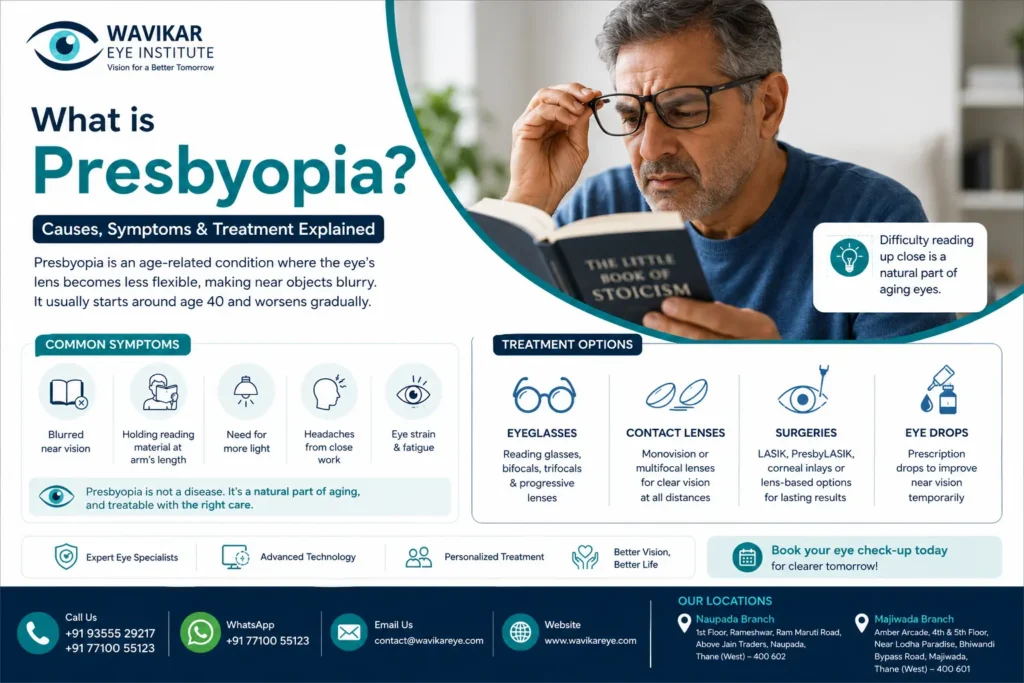
Presbyopia is the age-related condition where there is a loss of clear close-up vision that occurs when your eye’s lens becomes less flexible. In this condition, you might need to hold your book or phone out at arm’s length to comprehend the words clearly. It usually begins to develop around age 40 and gets worse until your mid-60s.
The word “presbyopia” breaks down into two Greek‑derived roots:
- “presby‑” (from Greek presbys) = “old age” or “elderly”.
- “‑opia” (from ōps / opia) = “vision condition” or “eye condition”.
So the literal breakdown is:
- presby‑ + op‑ia → “vision condition of old age.”
What are Presbyopia Causes
To understand the cause, let’s first understand how the eye normally focuses (accommodation)
Your eye works like a camera.
⬇️
When you’re young, the lens is soft and flexible.
⬇️
It easily changes shape to focus on nearby things.
⬇️
Ciliary muscles help the lens adjust automatically.
⬇️
This process is called accommodation.
⬇️
As you age, the lens becomes stiff.
⬇️
It can’t adjust as easily as before.
⬇️
So, close objects start to look blurry.
⬇️
This leads to presbyopia.
The key mechanisms of the cause are the following:
- Lens hardening over time.
- Loss of elasticity of lenses.
- Reduced ciliary muscle strength
Healthcare providers consider it a natural part of aging that usually begins in your 40s.
In simple terms, Age-related changes to your eyes cause presbyopia.
Apart from age, there are other risk factors, such as:
- Certain medical conditions.
- Being farsighted.
- Medications you take, for example, antihistamines, antidepressants, and diuretics.
- Lifestyle and environmental factors.
What Are the Symptoms of Presbyopia?
Here are the following symptoms that you may notice:
| Symptom | What it Means |
| Need for more light | The need for more light when you’re reading. |
| Blurred near vision | Text or objects at normal reading distance appear blurry rather than sharp. |
| Holding reading material at arm’s length | You may instinctively hold books, phones, or other reading material farther away to see them clearly. |
| Headaches from close work | Prolonged reading, writing, or screen use can trigger headaches. |
| Eye strain | Your eyes may feel sore, heavy, or tired, especially after doing detailed or up‑close work. |
People Also Ask
How is presbyopia pronounced? It is a five-syllable word which is pronounced like this: “prez-bee-OH-pee-uh.”
Difference Between Hypermetropia and Presbyopia
Are you wondering between two terms, “hypermetropia” vs. “presbyopia”? Here is the difference:
| Feature | Hypermetropia | Presbyopia |
| Definition | Refractive error: light focuses behind retina. | Age‑related loss of lens focus for near work. |
| Cause | Short eyeball or weak focusing power. | Aging lens and ciliary muscle. |
| Onset | Often childhood/young age. | Around 40–45 years. |
| Main vision issue | Blurry near vision, may see distance well. | Blurry near vision, distance often clear. |
| Correction | Plus lenses or refractive surgery. | Reading glasses, bifocals, or progressives. |
What Happens if Presbyopia Is Left Untreated?
If left untreated, here are the main effects:
- Worsening near‑vision difficulty
- More eye strain
- Frequent headaches
- Lower quality of life
- Decreased productivity
- Delay in detecting other eye issues
Presbyopia Treatment
An eye care specialist will conduct the proper eye examination. A crucial part of this examination is a refraction assessment to measure how well you see objects at specific distances.
This assessment will help your doctor understand whether you have presbyopia and/or astigmatism and also whether you’re nearsighted or farsighted.
If presbyopia is diagnosed, the treatment will depend on your health, lifestyle and preferences; your eye care specialist may suggest any of the following methods for presbyopia correction:
- Eyeglasses.
- Contact lenses.
- Surgeries.
- Eye drops.
| Treatment modality | Type / example | Main advantages | Main limitations / drawbacks |
| Eyeglasses | Single‑vision, bifocal, trifocal, progressive lenses | Non‑invasive, low cost, reversible, easy to adjust. | Need to carry glasses; visual discontinuities (“image jump” in bifocals), cosmesis issues. |
| Reading‑only glasses | Single‑vision “readers” | Simple, cheap, good for pure near‑vision support. | No distance vision; must keep separate pair. |
| Contact lenses (monovision) | One eye for distance, one for near | independence from glasses; good for active lifestyles. | Possible loss of depth perception, slight blur in both eyes, some patients cannot adapt. |
| Multifocal contact lenses | Soft or rigid gas‑permeable multifocal CLs | No glasses needed; good for computer‑intermediate use. | Glare, halo, reduced contrast and image quality in low light. |
| Corneal refractive surgery (LASIK‑monovision) | Laser‑based monovision correction | Long‑term freedom from glasses for many patients. | Dry‑eye aggravation; not suitable for all; may still need readers for fine print. |
| PresbyLASIK / multifocal LASIK | Multifocal corneal ablation profile | Reduces dependence on reading glasses. | Night‑vision symptoms (halos, starbursts), careful patient selection required. |
| Corneal inlays (e.g., KAMRA) | Tiny opaque ring implanted in cornea | Minimally invasive; reversible; preserves distance vision. | Possible corneal haze, dry‑eye, need for later removal in some cases. |
| Lens‑based surgery (IOL) | Monofocal, multifocal, EDOF, trifocal IOLs after cataract or refractive lens exchange | Can correct presbyopia and cataract simultaneously. | Surgical risk (infection, retinal detachment), higher cost, possible dysphotopsias. |
| Pharmacologic drops (pilocarpine‑like agents) | Low‑dose miotic eye drops (e.g., 0.4% pilocarpine) | Non‑surgical, temporary near‑vision boost. | Side effects (headache, eye pain, blurred vision, conjunctival redness, nausea). |
| Emerging internal therapies | Intracameral injections (e.g., UNR844, lipoic‑acid esters) | Potential to treat underlying cause, not just optics. | Mostly experimental; long‑term safety and efficacy under study. |
Can Presbyopia Be Cured Naturally?
No, it cannot be naturally reversed, as it is an age‑related hardening of the eye’s lens.
However, you can improve your eye health through:
- Good nutrition (vitamins A, C, E, zinc, lutein, omega‑3s).
- Avoiding smoking.
- Wearing UV‑protective sunglasses.
- Giving your eyes regular breaks by following the 20-20-20 rule.
- Staying hydrated.
- Limiting screen time.
- Regular eye checkups.
Conclusion
Presbyopia is a common part of aging; however, that doesn’t mean that you have to let it decrease the quality of your life. Consult your eye care specialist right away if you notice blurred vision or other eye symptoms.
Keep in mind, presbyopia isn’t a disease, but it shares symptoms with conditions that are more serious and hence require timely treatment. Your doctor will diagnose the underlying issue and give you the care you need.
Are you looking for the best presbyopia treatment hospital in Thane?
Contact Wavikar Eye Institute today for the right care, and do not let age-related conditions define your everyday life:
Contact us:
Call: +91 93555 29217/+91 77100 55123
WhatsApp:+91 77100 55123
Email: contact@wavikareye.com
Or visit our clinic:
Naupada Branch
1st Floor, Rameshwar, Ram Maruti Road,
Above Jain Traders, Naupada,
Thane (West) – 400 602
Majiwada branch:
Amber Arcade, 4th & 5th Floor,
Near Lodha Paradise, Bhiwandi Bypass Road, Majiwada, Thane (West) – 400 601