Skip to content
 Medically Reviewed
Written by Pooja Rawat, Medical Content Writer
You might have heard many people saying, “I can see the distant objects clearly, but nearby objects look blurry.” Well, this is a common eye condition known as hypermetropia, which is common across all ages.
Hypermetropia cannot be completely cured; however, with personalized treatment, it can be corrected, especially if diagnosed early. That’s why you must always visit for a general eye checkup and discuss preventive care treatment from the Best Ophthalmologists, like those at Wavikar Eye Institute, Thane.
Hypermetropia Definition
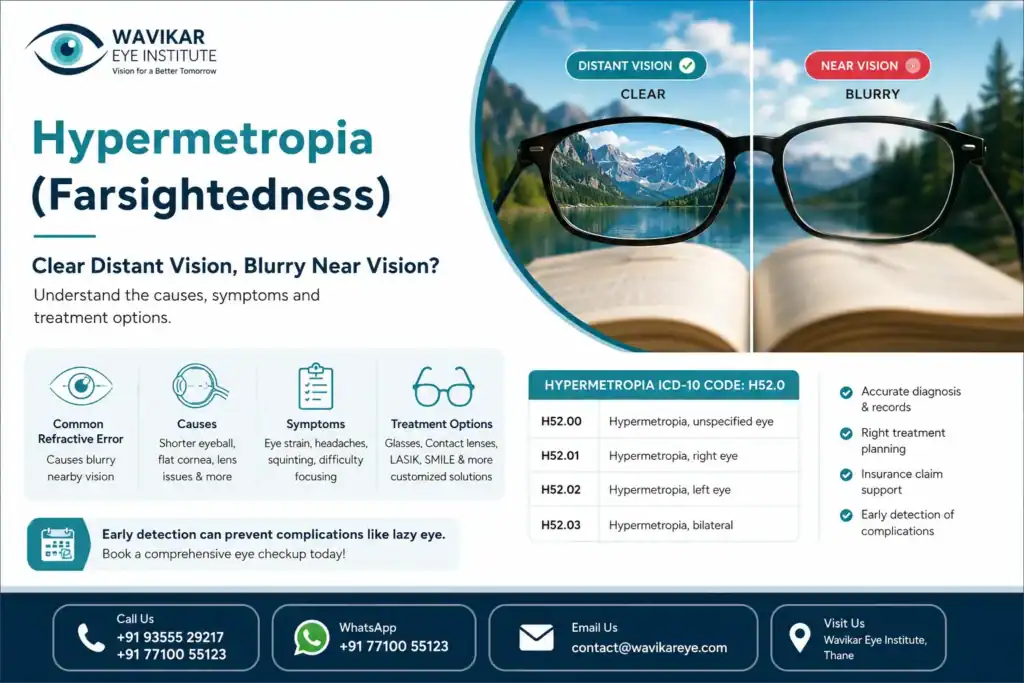
Hypermetropia (also known as hyperopia and farsightedness) is a common refractive error eye condition that may cause blurry close-up vision.
A refractive error is something about the natural shape of your eyes that makes your vision blurry. Farsightedness often occurs when the eye is shorter than normal or when the cornea has too little curvature, causing light to focus behind the retina.
Also Read : Myopia vs. Hypermetropia: What’s the Difference and How to Manage Them?
What are the Key Characteristics of Hypermetropia?
It is commonly identified by the following features:
Clear Distant Objects, But Blurry Near
You will notice distant objects are seen well; however, close-up items (such as phones and books) are blurry.
Focus Behind Retina
Light focuses behind the retina (the light-sensitive layer of tissue at the back of the eyeball), instead of directly on it.
Hypermetropia is also known as:
- Far-sightedness
- Long-sightedness
- Hyperopia
- Hypermetropia bilateral (Farsightedness affecting both eyes)
What are the Causes of Farsightedness?
In farsightedness, or long-sightedness, you can see distant objects clearly, but nearby objects appear blurry. Ophthalmologists at the Best Eye Center in Thane say it can happen due to the following reasons:
Primary Causes
Shorter Eyeball (The Most Common Reason)
When the eyeball is shorter from front to back, the light enters, but it doesn’t have sufficient distance to travel to land on the retina. As a result, the image forms behind the retina instead of directly on it, making nearby objects appear blurry.
Flat Cornea
The cornea (the eye’s front surface) doesn’t curve enough; light rays do not bend enough. This leads to light focusing behind the retina instead of directly on it, making close-by objects blurry.
Lens Issues
The eye’s natural lens may sit too far back, and it loses its bending power. Lifestyle diseases like high blood sugar can also make the lens swell, leading to blurred nearby images.
Other Contributing Factors
Genetics
If the condition runs in the family, it can influence eyeball length, corneal curvature, and the position of lenses.
Age (Presbyopia)
Your eye’s lens naturally loses flexibility, making it harder to focus up close, a condition known as presbyopia. This can start around age 40 and can exacerbate hyperopia.
Smoking During Pregnancy
Chemicals from the smoke can affect delicate eye structures, negatively influencing the retina and optic nerve. If pregnant women smoke during pregnancy, it can increase the risk of moderate to high farsightedness for the child.
Medical Conditions
Diabetes leads to fluctuations in blood sugar, causing swelling of the lens. This can lead to temporary farsightedness or persistent shifts in vision, including farsightedness.
Abnormal growths (Rare conditions like tumors) near the eye or optic nerve can also be a contributing factor.
Also Read: Eye Stye(Sty) Explained: Causes, Symptoms, And How To Treat Them
Symptoms of Hypermetropia
Here are some common symptoms of farsightedness.
- Blurry nearby objects
- Eye strain
- Frequent headaches
- Difficulty focusing
- Squinting
- Feeling irritable or tired after prolonged concentration
- Symptoms in children may include rubbing eyes often, headaches, or disinterest in reading.
Treatment of Farsightedness
There is no permanent cure, but it can be effectively managed with the help of personalized treatment. Early treatment in children avoids serious complications such as lazy eye.
The treatment may vary based on the severity of the condition, age, and other individual factors. The main aim is to help focus light on the retina through various procedures, as mentioned below.
- Eyeglasses
- Contact lenses
- Corrective lenses for hypermetropia (Convex lenses)
- Implantable lenses
- Customized exercises
- LASIK (Laser-assisted in situ keratomileusis)
- SMILE (Small incision lenticule extraction)
Hypermetropia ICD 10
Hypermetropia in ICD-10 refers to H52.0.
Specific ICD-10 Codes for Hypermetropia | What it Means |
H52.00 | Hypermetropia, unspecified eye |
H52.01 | Hypermetropia, right eye |
H52.02 | Hypermetropia, left eye |
H52.03 | Hypermetropia, bilateral |
Doctors use H52.0 to:
- Record this eye problem clearly for bills and records.
- Helps recommend the right glasses or treatment fast.
- Tracks how common it is.
- Helps insurance pay claims.
- Spots risks like eye strain early.
To Summarize
There is no cure for farsightedness, but Wavikar Eye Institute highlights that early detection can prevent it from becoming severe. All you need is to visit an Ophthalmologist at the Best Eye Center in Thane, go through a comprehensive eye test, and follow all their advice.
When to Consult the Best Ophthalmologist in Thane for Hypermetropia
Consult the Best Eye Specialist in Thane in a timely manner if you have the following scenarios:
- Frequent headaches
- Constant eye strain and fatigue
- Difficulty performing daily activities
- Frequently squinting
- Severe eye pain, flashes of light
- Change in vision
- Existing health conditions like diabetes, which can influence your eye health
Do nearby objects look blurry? Then it’s time to schedule a call.
Contact us:
Call: +91 93555 29217/+91 77100 55123
WhatsApp:+91 77100 55123
Email: contact@wavikareye.com