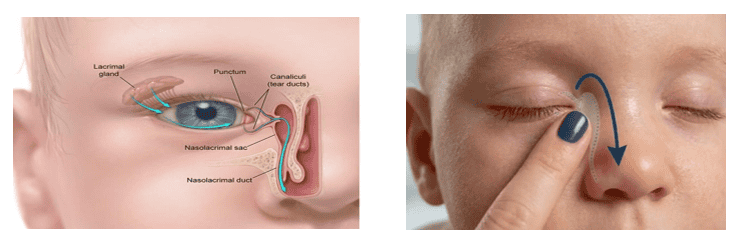
Congenital nasolacrimal duct obstruction (CNLDO), commonly known as a blocked tear duct, is a frequent condition seen in newborns and young children. It occurs when the normal drainage pathway that carries tears from the eye into the nose is not completely open at birth. In most babies, the obstruction is caused by a thin membrane at the lower end of the tear drainage system that has not opened normally. It is usually present from birth and is not caused by anything the parents have done.
The most common symptom is persistent watering of one or both eyes. Parents may also notice sticky or yellowish discharge, particularly after sleep. The eyelids may occasionally become crusted or stuck together. Importantly, the eye itself is usually not red.
Symptoms may become more noticeable during cold weather or when the child has a cold, as nasal congestion can further interfere with tear drainage.
In most of the cases congenital blocked tear ducts open naturally during the first year of life. A lacrimal sac massage help in early opening of the duct. Antibiotic eye drops may occasionally be prescribed when there is significant discharge or infection.
If watering and discharge persist beyond one year of age, or if the child develops recurrent infections, the paediatric ophthalmologist may recommend a procedure called probing, in which the obstruction is gently opened using a fine probe
 Call Now
 Book Appointment
 Enquire Now